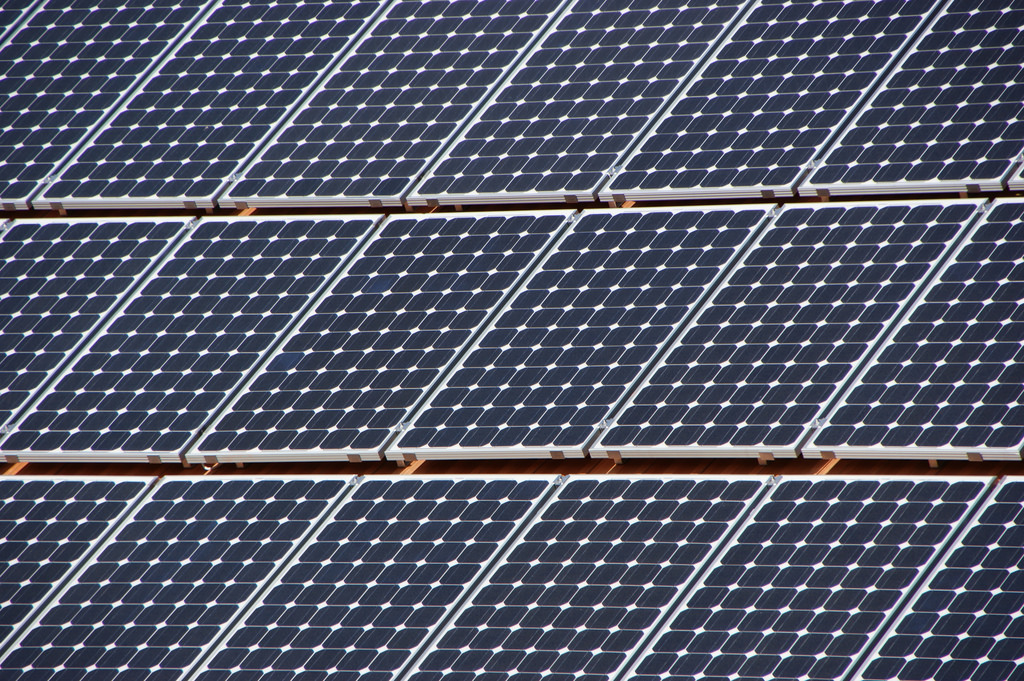
Solar cells convert light energy into electrical energy using what is known as the photovoltaic effect, using the fact photons are absorbed by electrons when incident on a metal surface.

What is a solar cell made of?
Solar cells are made of silicon, the same as most LEDs and diodes. They will contain 3 sections: a P-type, an N-type and a P-N junction. The p-type has a lack of electons (or abundance of holes) and the n-type has an abundance of electrons. The two sections are then separated by the P-N junction.
The photovoltaic effect
Electrons are found in energy levels. The lowest energy state is the valence band, to conduct electricity the electrons must be in the conduction band, with the difference between the two known as a band gap.
The band gap in conductors is so small that free electrons are almost always available to conduct electricity. Insulators, on the other hand, have such a large band gap that photons in sunlight don’t have enough energy to overcome this energy difference. Therefore, semiconductors are the ideal material to use. Due to the P and N type materials, an electric field is produced so when the electrons are freed they will flow.
When sunlight hits the semiconductor in the solar cell, the photons are absorbed by the electrons and this gives them the energy to be freed. As they are negatively charged, they will be attracted towards the positive side of the cell. This produces a flow of current and therefore generates electricity.
They are effectively the opposite of an LED, which uses electricity to produce light. More on LEDs here.
Viability of solar cells
The most obvious benefit of solar cells is that they are renewable and produce no waste gases such as carbon dioxide. However, there are a number of issues with widespread use of solar cells.
Firstly, cost is an issue. They cost around £5000 to install for a home and will only save about 50% on electricity bill. Solar power plants cost a significant amount as well but produce considerably less electricity than the coal equivalents. Over the last few years, however, the cost of installation has seen a significant reduction but a lot of development will be needed to make this a cost-effective solution to the energy crisis.
Another issue is that, especially in the UK, sunlight isn’t always predictable so the production of power will see fluctuations and at night no electricity can be produced.
Clearly solar cells do have their benefits, but some issues will need to be resolved before they take over from our current power stations.
References
http://solarbotics.net/starting/200202_solar_cells/200202_solar_cell_physics.html
http://www.physics.org/article-questions.asp?id=51
https://science.nasa.gov/science-news/science-at-nasa/2002/solarcells