There are four fundamental forces of nature: gravitational, electromagnetic, strong and weak. Each force can be explained using fields and 3 also have bosons associated with them, known as force carriers.

Gravitational
The gravitational force is an attractive force which acts on everything with mass. Although it is responsible for holding planets in orbit, it is actually the weakest of the four forces.
Although gravity is the only force which we actually experience ourselves, it is actually the force we know the least about. All other fundamental forces have a guage boson associated with them, a part of the standard model. Many theories predict the existence of the graviton, the force carrier for the gravitational force. This particle would have zero mass, due to the infinite range of gravity, and also would be the only boson with a spin of 2.
However, despite its unique properties, detection has proved a challenge. As the weakest force, detecting a single graviton would require extremely sensitive equipment. In particle physics, the force of gravity is so weak that it has a negligible effect so the fact it hasn’t been combined in standard model is not a huge issue. When on the larger scale, for example in cosmology, then general relativity is used to describe the force.
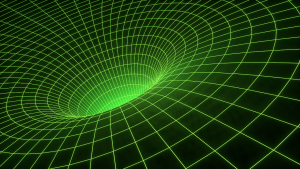
Einstein described gravity as a distortion in space time, with objects of mass causing space time to bend. This could then be used to explain why two particles travelling parallel to one another may collide. Newton’s theory of gravity suggested that an external force acted and caused them to change direction. Einstein, however, thought that the particles actually continued in a straight line but due to the bending of space time, the two parallel lines meet.
Electromagnetic
The electromagnetic force is the only other fundamental force which has an infinite range, so can be observed outside of an atomic nucleus. Like gravity, it obeys the inverse square law – meaning that force is inversely proportional to the square of separation. But unlike gravity, it can be both attractive and repulsive.
Made up of the force between charged particles (electric force) and magnetism, the electromagnetic force on a fundamental level is an exchange force carried by photons. It is responsible for holding atoms and molecules together, with protons and electrons attracting one another.
Strong Nuclear
The strong nuclear force, as the name suggests, is the strongest of the four fundamental forces. However, it has a range of just 10-15m. Acting inside the nucleus of atoms, the strong force holds together the protons within the atomic nucleus and the quarks inside the nucleons.
Explained using quantum chromodynamics, the strong force is mediated by the gluon. Each quark inside a baryon (eg proton or neutron) is assigned a colour charge. The exchange of gluons alters the colour of the quark but due to the conservation of colour, this in turn results in another quark changing colour charge and then exchanging more gluons.
Because leptons do not have the property of colour, they do not experience the strong force. This explains why particles containing quarks, protons and neutrons, are found within the nucleus of an atom but electrons (which are leptons) are not.
Weak Nuclear
The weak force is actually stronger than the gravitational force but only acts in a very short range and is around 10-16 the strength of the strong nuclear force. Involved in the decay of particles, the weak force has 3 gauge bosons. These are the Z0, W+ and W–.
The weak interaction allows quarks to change flavour, meaning they can become a different type of quark. This is especially important in processes such as fusion and the formation of heavy nuclei.
It can be used to describe beta decay, in which a neutron turns into a proton. This process requires a down quark to change to an up quark. This occurs due to the release of a W– boson which decays into an electron and an anti electon neutrino.
References
https://www.livescience.com/49254-weak-force.html
http://hyperphysics.phy-astr.gsu.edu/hbase/Forces/funfor.html