The standard model describes four fundamental forces; gravitational, electromagnetic, strong and weak. How is gravity different? Each of the forces is thought to have one or more gauge boson associated with it, the fundamental particle exchanged when the force acts.For three of the four forces, this force carrier has been found, but for gravity it is yet to be detected. In order to fit gravity into this model, it would also need to be shown to be quantiseable.

Gravity is the most closely related to the electromagnetic force. Both forces act with an infinite range and also obey the inverse square law. This means that the equations used to describe them on a large scale are very similar. One of the key differences is that the electromagnetic force can be both attractive and repulsive whereas gravity can only be attractive, as mass is a scalar quantity. The electromagnetic force is also much stronger than gravity, meaning that experiments can be carried out a much smaller scale and require less sensitive equipment.
The other two fundamental forces are referred to as the nuclear forces due to the fact they act within the atomic nucleus, with a range of just 10-15m – the approximate radius of the nucleus of an atom. Responsible for holding quarks together within nucleons, the strong force is the strongest of the four fundamental forces – 1041x stronger than gravity. Quantum chromodynamics is crucial to our understanding of how the force arises, using coloured charge to explain how the gluons are exchanged by quarks.
The final fundamental force, the weak interaction, is unique in that it can change the identity of quarks. With 3 gauge bosons, the and, it is also the only fundamental force with more than one force carrying particle. The charges on the bosons means that the quarks involved in the interactions can change flavour without making the charges become unbalanced. Crucial for nuclear fusion, the weak force is responsible for protons changing to neutrons.
Although gravity is the force which we are the most familiar with, we understand the least about it. This is mostly due to the fact that it is incredibly weak. No gauge boson has yet been detected, but it is believed that one does exist. This hypothetical particle is called the graviton, and predictions have already been made to describe the properties of this particle. Firstly, due to the fact that gravity has an infinite range, the graviton must have zero mass, like the photon. It is also thought to have a spin of 2, rather than 1 for all other gauge bosons. This unique property does mean that if a spin 2 boson is detected, it is very likely to be the graviton. However, the detection of this hypothetical particle has proved very challenging.
One of the key issues with detecting gravitons is how weakly they interact with matter. In their paper on detecting gravitons Rothman and Boughn showed that a detector with a mass equal to Jupiter put in close proximity to a neutron star would detect just one graviton in 100 years. Also, without any shielding, this detector would also detect about 1034 neutrinos for every graviton, making it impossible to determine whether a graviton has been found. Adding shielding to block out the neutrinos would require so much additional mass that it would collapse into a black hole. Therefore, this method of detection is not at all feasible even with better technology than we currently have.
Particles such as electrons and photons interact in a way that can be renormalized, meaning that they don’t continue producing an endless string of particles during interactions. Gravitons however, are able to produce more gravitons. This is because they carry high amounts of energy when confined to a small space, this results in more gravitons being produced, therefore increasing the energy and this cycle continues. As graviton production continues infinitely, this process is described as non-renormalisable and requires string theory to explain.
Detecting gravitons directly is not the only way that their existence can be proved. When the electron was first shown to exist, this was before the first electron was detected individually. Likewise, if a good theory of quantum gravity is developed and the predictions it makes can be proved experimentally then it can show that gravity must be quantized, therefore indirectly proving the existence of the graviton.
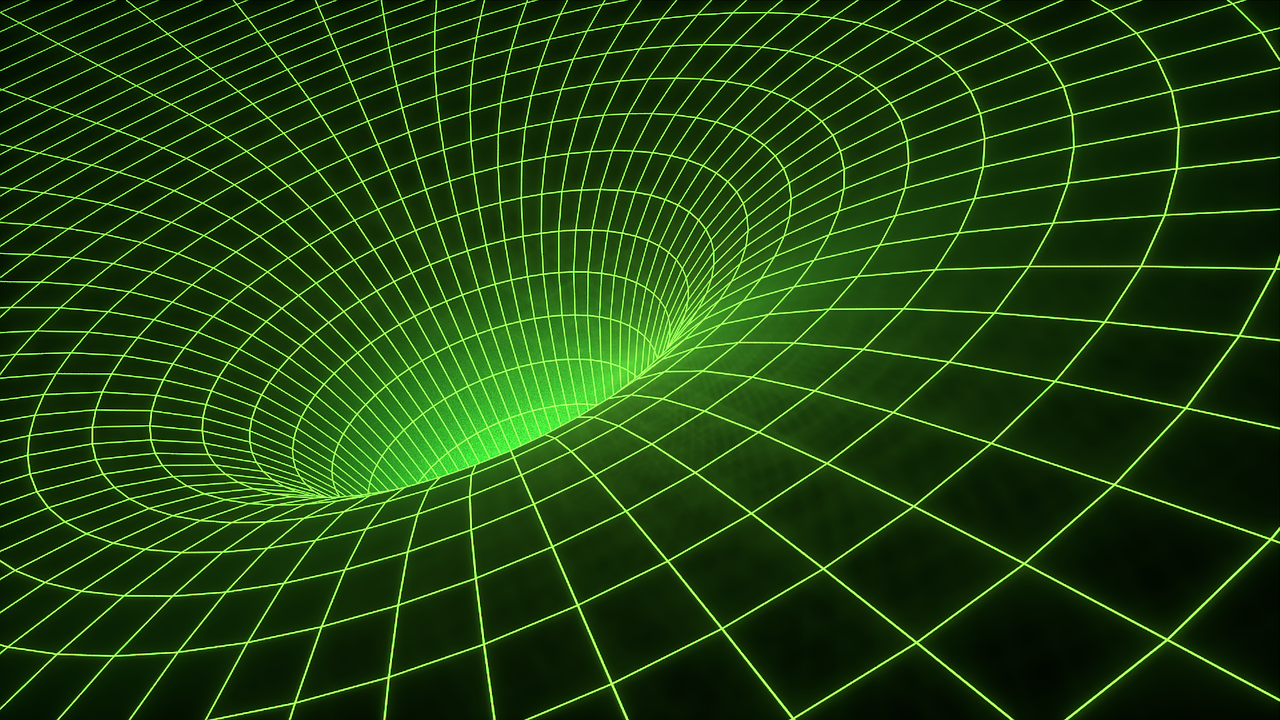
Einstein’s general relativity suggested that gravity may not be a force at all. Instead a force appears to act due to the distortion of space time. The theory explains that any massive particle will curve space time. This means that the apparent forces between objects such as the planets around the sun is actually just the planets moving in the straightest possible path along the curved space. As they are moving in a straight line, there is therefore no resultant force acting. This theory also suggests the existence of gravitational waves. And, like electromagnetic waves, it is thought they may actually be made up of particles – the graviton.
Gravitational waves are produced when an object with mass moves. The waves move at the speed of light, but are incredibly weak so very difficult to detect. However, the LIGO detector in the US has recently detected these gravitational waves. Made up of two separate L-shaped detectors about 2.5km long, it calculates the time taken for a laser beam to travel down each leg. Gravitational waves would cause them to change length and therefore the time difference for each can be found, showing the presence of a gravitational wave. So far the detectors have detected gravitational waves 4 times, from the merging or black holes or neutron stars, which produce high energy gravitational waves.
This discovery strongly supports Einstein’s theory of general relativity. It also suggests that gravitons do exist as force carriers for the graviton, with gravitational waves similar to electromagnetic waves in this way. However, the current quantum gravity theory doesn’t match observations of gravity at high energies, so there is still a long way to go before gravity is understood as well as the other fundamental forces.
References
home.cern/about/physics/standard-model
www.space.com/38471-gravitational-waves-neutron-star-crashes-discovery-explained.html
science.howstuffworks.com/environmental/earth/geophysics/fundamental-forces-of-nature.htm
https://science.howstuffworks.com/environmental/earth/geophysics/question232.htm